
The Importance of Properly Installed Through Wall Flashing in Residential Masonry Construction
Water management is one of the most important and least understood aspects of residential masonry construction. Brick veneer walls are designed to manage water, not completely stop it. Even well constructed brick masonry will absorb and transmit some moisture during rain events. Because of this, proper moisture control systems must be installed to collect and direct water safely back to the exterior before damage occurs.
One of the most critical components in this system is through wall flashing, often referred to as TWF.
As shown in the diagram below, through wall flashing works together with the airspace and weep holes to create a drainage plane behind the masonry veneer. When installed correctly, this system allows water that enters behind the brick to drain harmlessly back outside the building.
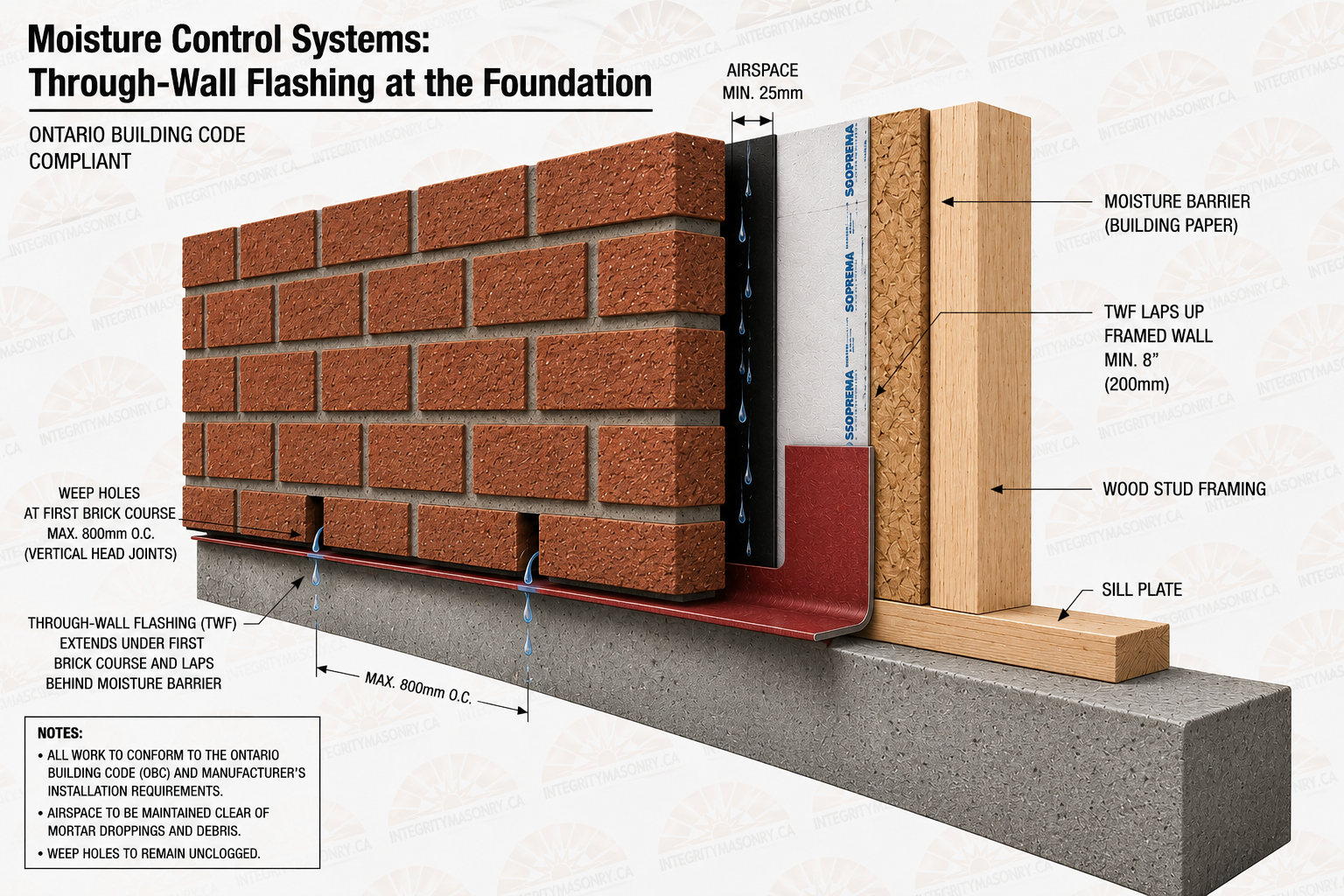
TWF at Foundation
Why Through Wall Flashing Matters
Brick and mortar are porous materials. During wind driven rain, moisture can pass through masonry joints and units and enter the cavity behind the veneer. This is normal and expected.
The problem occurs when that water has nowhere to go.
Properly installed through wall flashing collects water at key transition points and directs it out through weep holes. Without it, water can accumulate inside wall assemblies and migrate into framing, insulation, sheathing, drywall, flooring, and finished interior spaces.
Over time, this can result in:
Rotting wood framing
Mold growth
Interior water leaks
Efflorescence staining
Freeze thaw masonry damage
Rusting steel components
Deteriorated insulation performance
Structural deterioration
Expensive hidden damage inside walls
In many homes, water damage related to missing or poorly installed flashing can continue for years before becoming visible inside the building.
Through Wall Flashing at Foundations
At the base of masonry walls, through wall flashing should extend beneath the first course of brick and lap properly behind the moisture barrier.
This flashing intercepts water draining down the cavity and redirects it outward through weep holes located in the first brick course.
Without proper flashing at the foundation level, water can collect at the base of the wall and saturate framing materials near the sill plate and lower wall assembly. This area is especially vulnerable because it often remains hidden behind finished basement walls or flooring systems.
Common deficiencies include:
Missing flashing entirely
Flashing that does not extend through the wall
Improper laps behind the moisture barrier
Blocked or missing weep holes
Flashing sloped inward instead of outward
Mortar bridging the drainage cavity
Flashing terminated too low or too high
Even a small installation defect can compromise the entire drainage system.
Through Wall Flashing Over Openings
Windows and doors are among the highest risk areas for water entry in residential construction.
Above openings, through wall flashing and lintels must work together to redirect moisture safely back outside before it reaches the framing below.
When flashing is absent or improperly integrated above windows and doors, water can enter the wall cavity and migrate downward into sheathing, framing, insulation, and interior finishes.
Symptoms often include:
Water staining above windows
Interior drywall damage
Mold around window openings
Deteriorated wood framing
Rusting steel lintels
Cracked masonry above openings
Efflorescence on brick surfaces
Many homeowners mistakenly assume leaking windows are caused by failed caulking alone, when the actual issue is hidden moisture control failure behind the masonry veneer.
Through Wall Flashing at Second Storey Splits
Second storey wall transitions and split elevations are another common failure point.
Whenever a masonry wall steps down or intersects with a lower roofline, balcony, or framed wall section, through wall flashing must be properly installed to intercept and drain water at the transition.
These areas are exposed to concentrated water flow during heavy rain and snow melt. Without properly detailed flashing systems, water can penetrate deep into concealed framing assemblies.
Improperly flashed second storey splits frequently lead to:
Persistent interior leaks
Rotting wall framing
Wet insulation
Mold growth inside exterior walls
Brick displacement and movement
Damage around roof intersections
Because these areas are often difficult to access and visually inspect, problems may remain hidden until significant deterioration has already occurred.
Proper Installation Is Critical
A moisture control system is only as effective as its installation quality.
Proper through wall flashing installation requires:
Correct flashing materials
Continuous drainage paths
Proper laps and shingling methods
Positive outward drainage
Clear airspaces
Properly spaced weep holes
Integration with moisture barriers and adjacent assemblies
Attention to transitions and penetrations
Even high quality materials will fail if installation practices are poor.
Unfortunately, many residential masonry failures stem not from material defects, but from shortcuts taken during construction.
Integrity Masonry Specializes in Moisture Control Repairs
At Integrity Masonry, we specialize in diagnosing and correcting residential masonry water entry problems related to failed or improperly installed moisture control systems.
Our work includes:
Through wall flashing replacement
Weep hole correction and installation
Masonry reconstruction
Lintel replacement
Water entry investigation
Brick veneer repairs
Moisture management detailing
Masonry restoration around windows and doors
Second storey split repairs
Structural masonry rebuilding
Many moisture related masonry problems cannot be permanently solved with surface caulking or cosmetic patch repairs alone. Proper correction often requires rebuilding affected areas and restoring the original drainage system behind the masonry.
Our focus is on identifying the root cause of water entry and correcting the assembly properly so the problem does not return.
Final Thoughts
Water intrusion behind masonry veneer is not a rare issue in residential construction. It is one of the most common causes of hidden building deterioration in Ottawa homes.
Properly installed through wall flashing at foundations, over openings, and at second storey transitions is essential to long term building durability and moisture protection.
When these systems are missing, poorly installed, or compromised over time, the resulting damage can become extensive and expensive.
Understanding how masonry moisture control systems function is critical for homeowners, builders, and property managers alike. Early diagnosis and proper repair can prevent far more serious structural and interior damage in the future.
