
Earlier this year, I intended to write and post a blog about something that’s been bothering me for some time: Fake Reviews. As a local Ottawa small business owner since 2008, I’ve seen Integrity Masonry’s online reputation management ecosystem change dramatically, and for the worse. Mariya Postelnyak hit the nail on the head with her article: Fake reviews are multiplying. Will you spot one before it costs you? - The Globe and Mail, published on July 16th, 2026. I encourage Ottawa homeowners to read it before hiring for home repair and construction services. What follows is my experience in business.
Background and Context
When I started out in Summer 2008, I was operating out of a family minivan with the back seats removed. There was just enough room for a wheelbarrow, a shovel, a few bags of mortar, a stack of bricks, and my bag of tools and levels. That year I had earned my Red Seal Certificate of Qualification in the trade after a 4-year apprenticeship. I had married and had my first child, so it was busy to say the least. Going by the name, Integrity Masonry, I was operating as a sole-proprietor and I had an established property management company feeding me small repair work all around central Ottawa. At this stage I had no online presence to speak of. Just word-of-mouth referrals.
That Fall, I remember laying brick one day while listening to CFRA as I had done for years. They were reporting sudden bank failures and insolvencies as the global financial crisis struck. With a new baby at home and an infant business to match, I got nervous. Fortunately, I crossed paths with a young couple in Barhaven who offered to design a modern website for Integrity in return for masonry services. This was a very lucky break because at the time, contractor websites were far behind even the sluggish standards of those days. The website they created for me looked slick, with high-resolution job photos and ‘calls-to-action’ in all the right places. Google search was developing at the time and Google liked my new site, it seemed. Commonly searched keywords appeared naturally in headings and narrative sections on the site. Compare this to other websites at the time where an exhaustive list of keywords was often just dumped at the bottom of the webpage.
In season 2, I was off to a cracking start. I had a modern-looking online presence and a great reputation with my suppliers and customers. I was earning a reputation as someone who was willing to go further than others to satisfy my clients while performing clean, code-compliant professional masonry services.
Earning Online Reputation
New customer inquiries started rolling in, which enabled me to hire and grow. In those early years, I was among the first masonry contractors in Ottawa to use Google Adwords which is a keyword-based advertising scheme that has made Alphabet rich. The way it works is this: In a defined geographical area, businesses can ‘bid’ on keywords that matter to them. For example, if someone were to use the google search bar to find “Ottawa chimney repair contractors”, my business could appear as a paid advertiser at the top of the search results. If the searcher clicked on my ad, they would be linked to my website and google would charge me the going market rate for that keyword referral. When I started using this program, the cost-per-click for the term “masonry Ottawa” was around 6 cents. Last I checked, it costs multiple dollars per click due to intense competition. I haven’t used Google Adwords since those early years. My main takeaway from the experience was that appearing online where my customers were searching was going to be critical. My focus, instead of paying-per-click, would be on organic search visibility. Or, to put it another way, just being among Ottawa’s most credible, relevant, and recognized masonry contractors in terms of reputation and content, in local online search.
In 2013, the Better Business Bureau of Ottawa notified me to say that one of my customers had nominated Integrity Masonry for the annual Torch Award for Marketplace Trust in the Home Improvements category. I was pleasantly stunned because it was not expected. I took care to fill out the nominee submission package. Questions related to my company’s mission, vision, and values were answered long hand, which moistly boiled down to the company name. The nominees were to be considered by a committee of business owners, and the winners were to be announced at an awards banquet in the Fall. Unfortunately, the date was set during a family vacation to Mexico, so I was not able to join my team. I was sitting at breakfast with my family when I received the excited call that we had won! What made this award special was that it was 100 percent based on merrit. The award could not be bought, which is relevant later in this post.
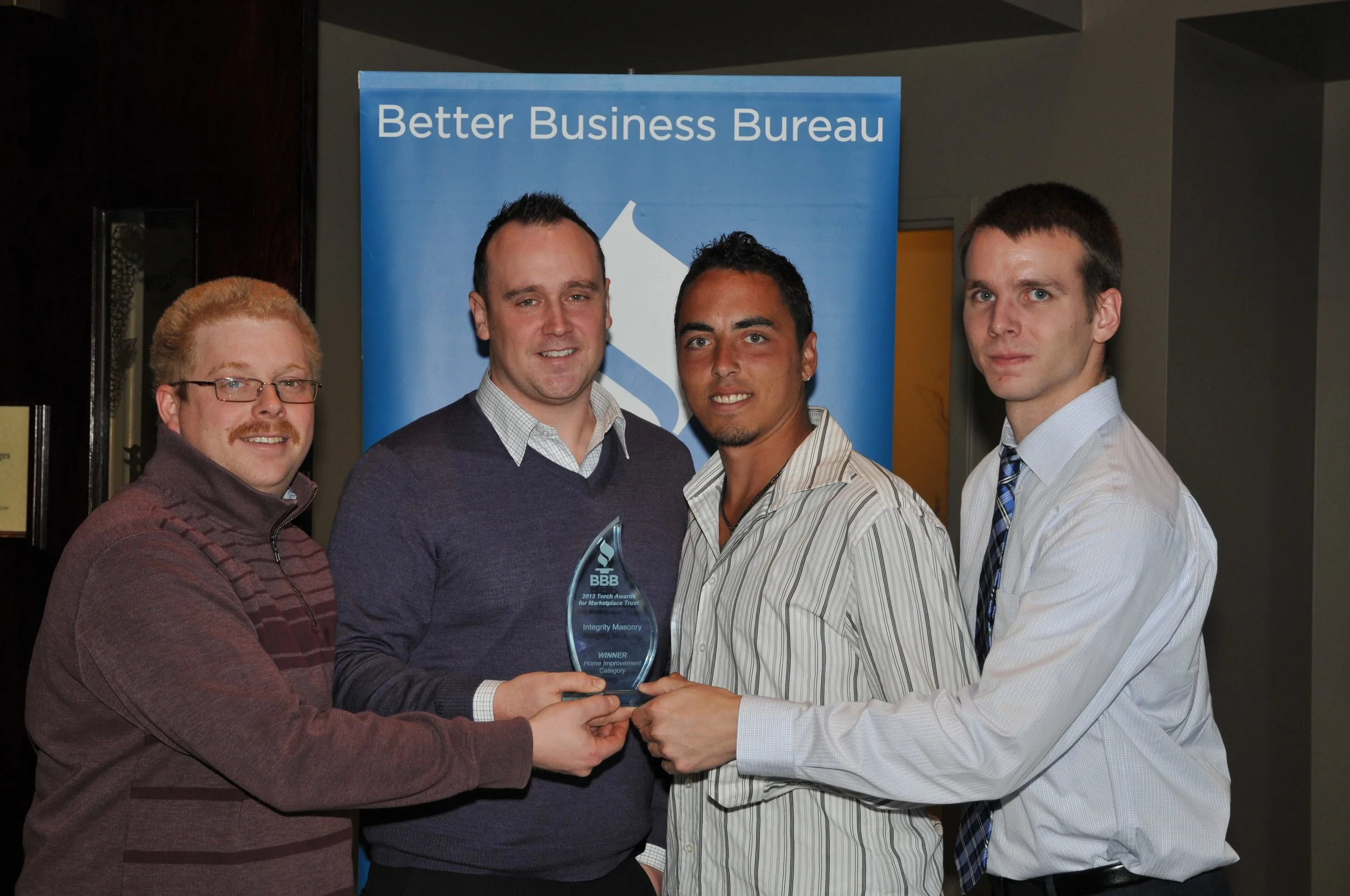
Integrity Masonry team receiving BBB Torch Award for Marketplace Trust in Home Improvements, 2013
It was around the middle twenty-teens that I started paying attention to online reviews. Many platforms offered consumers a chance to rate and comment on businesses, including but not limited to Google, Facebook, Yellowpages, Trusted Pros, Houzz, Homestars, Instagram, the BBB among many. I didn’t want to place all my eggs in one basket, so at the end of each job, I began listing links to these platforms and begging for reviews. I found that many people didn’t have the online savviness to do it, which is fair. But my younger and internet savvy clients were sometimes glad to do so. I was neurotic about getting positive feedback so I bent over backwards for my customers, ensuring that my team did so as well. We’d often quote work with a little extra room in the price. When all went well, we’d return it to the client by providing a little extra value. We’d fix a gate that wouldn’t shut. Or we’d repoint an extra area of brickwork that had gone unnoticed. At invoice time we’d ask for a review. Chugging along like this, we managed to earn around 10-20 reviews per year across platforms. I was hard work. But it was earned.
Review Fraud
At least 5 years ago, I noticed that the review game started to break. Google had become the only online review platform that mattered because of its unrivalled market power. And the behaviours detailed in the Globe & Mail article began for me. I was getting endless phone calls and emails from near and very far “businesses” selling google reviews. They boasted very authentic-looking 5-star reviews. They promised untrace-ability and local content and pictures. Of course, I ignored these offers because we were doing just fine acquiring legitimate reviews from our customers. Not to mention that this type of fraud does not align with company values. In the Spring of 2026, one of these groups posted an unsolicited five-star google review to Integrity’s Google business profile to “demonstrate” their services. I flagged it with Google immediately, explaining that it was fraudulent, and to their credit, Google quickly removed it.
This type of fraud has devalued the hard work and legitimately earned online reputations of many in the home improvement and repair industry. It is a poison that has been injected into the business of placing customer satisfaction above profit margins. Now, when I see competitors and new entrants to the local masonry service sector go from zero to 100 positive reviews in a short period of time, I can’t help but wonder if they’ve paid for it. Afterall, I know how hard it is to acquire legitimate reviews.
I once took pride in having a perfect suite of 5-star reviews on google. It was a badge of honour and a sign of success. To be clear, there have been disagreements with customers, but we’ve always worked them out in good faith. I suppose that none of our customers have been left feeling no other recourse but to smear us with a highly negative review. I consider that a win. More recently, I realized that people might doubt our good record, the way I do when I’m shopping online. I am a local consumer as much as any of my customers, and when I go seeking services, I can’t help but look at positive online reputation markers with increasing skepticism.
This past Spring, we earned our first 1-star review on google. The gentleman didn’t like our quote. He also posted a 1-star review for a competitor whose quote for the same repair also failed to convince him. It bothered me for a moment. But at least it was authentic, so now I’m grateful.
Awards For Sale
Another shell game in online reputation management that bothers me, is the increasing prevalence of so-called “awards”. We’ve all heard of online-only businesses that make people rich. I suspect that this is one of them, given their proliferation in recent years. Here’s how they work:
I own a numbered company that selects the annual winner of the “Number One Super-Fantastic [insert trade here] Company in [insert city here]”.
I do a simple google search in any market in any city in the world for each trade category. In this example, we’ll do “masonry” in “Ottawa”
I send emails to those top ten competing masonry companies in Ottawa, telling them that for 3 easy payments of $400 + HST, they will be selected as the exclusive winner of the “Number One Super-Fantastic Masonry Company in Ottawa”.
The company pays, and I give them the right to post a very nice looking award seal or badge that they can place on their website, on their trucks, and in all their advertising. For the purposes of this blog post, I asked ChatGPT to “Create an online award badge image for the ‘Winner of the 2026 Super-Fantastic Masonry Company, Ottawa’”. Here’s what it came up with on its first try:

BS Award made up using AI in seconds
Unlike the BBB Torch Award, many awards are simply bought and they mean nothing whatsoever. Consumers need to know this.
Speaking of AI
I hope the reader has found some value in this post. I don’t know what the future in online reputation management is going to be, but I can tell you that this year, 2026, is the first year that I have begun hearing from customers who were referred to Integrity Masonry by ChatGPT and Claude, among other AI platforms. This is new and I have no doubt that eventually someone is going to find a way to exploit and abuse it.
-Nick Ford on July 17th, 2026
